DoctorCopilot
DoctorCopilot turns uploaded medical reports into readable patient context, doctor review views, trend history, permissions, chat, and follow-up care.
The product is built around one rule: process a report once, store the result well, and let the rest of the application read that medical state without rerunning expensive AI on every screen.
Try the live DoctorCopilot product yourself.
This page is meant to stand on its own, but the live demo lets people verify the product directly: patient dashboard, doctor review, case insights, linked reports, and follow-up actions.
Medical PDFs become readable case context.
The project reduces repeat reading and fragmented report review by converting uploads into trends, summaries, permissions, and case actions.
Six-stage intake pipeline with stored clinical reuse.
AI runs at upload time, then downstream dashboards, insights, and exports read stable structured state instead of rerunning the model.
A true split between UI and API layers.
The interface is deployed on Vercel while Railway runs the backend APIs and report-processing services.
Credibility comes from traceability, not just extraction.
The strongest product decision was making provenance, permissions, and report context visible all the way through doctor review.
Real interface proof, not just a written walkthrough.
These screens come directly from DoctorCopilot and make the product legible at a glance: how a user gets in, what a patient sees, how trend analysis works, and how the doctor-facing workspace is organized.
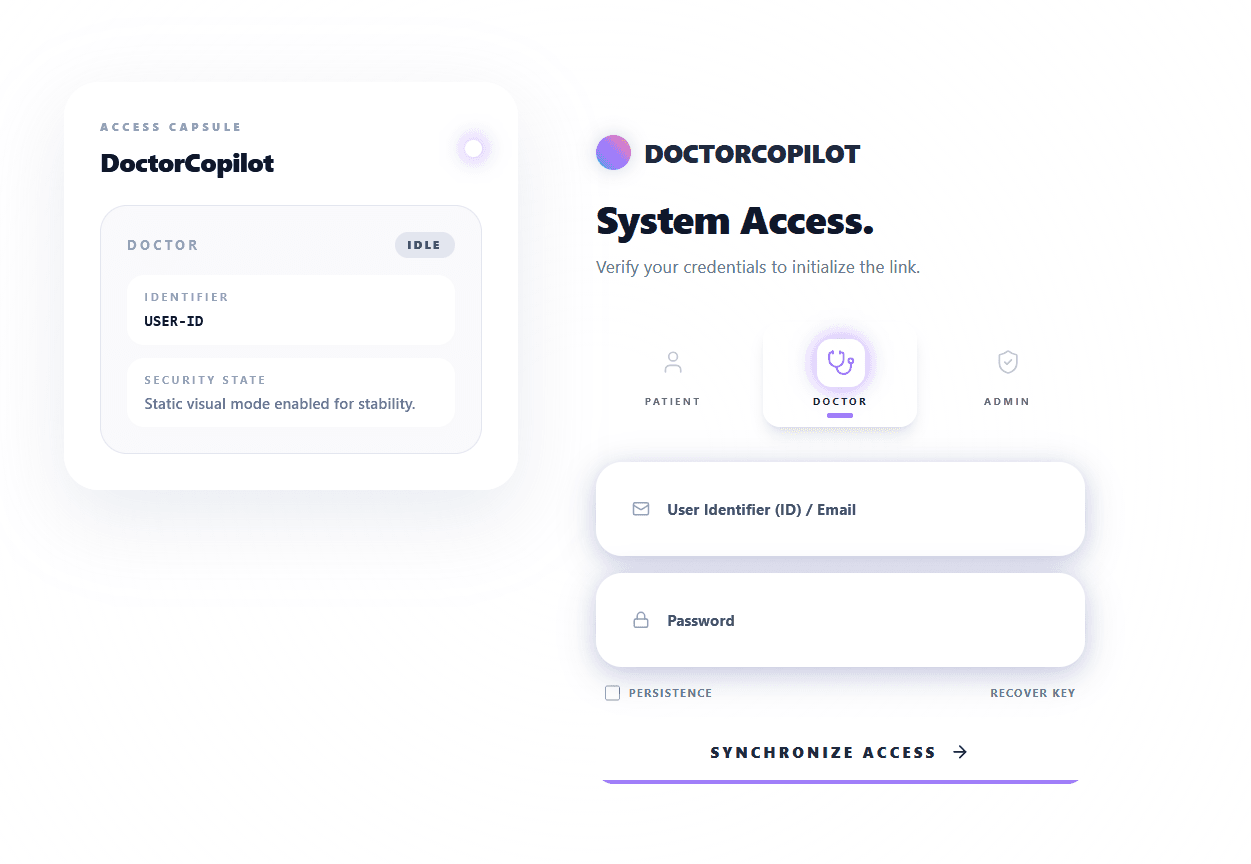
System access
The access screen already feels like a finished product instead of an internal tool. It sets up role-based entry clearly before the user reaches the medical workspace.
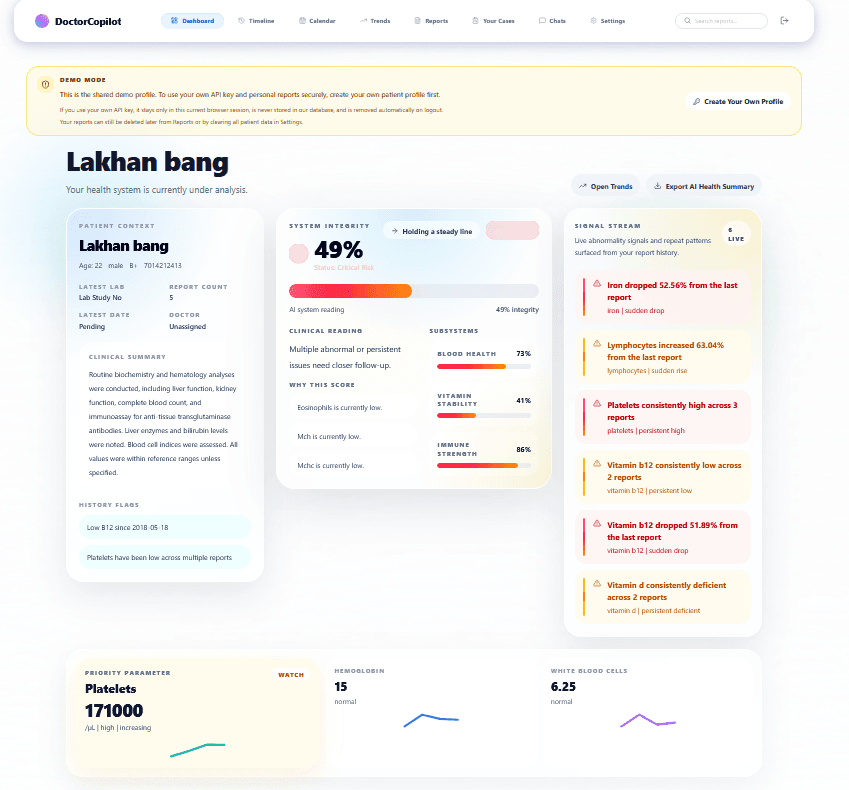
Patient dashboard
The patient dashboard turns reports, integrity signals, and abnormal markers into one readable overview with clear next actions.
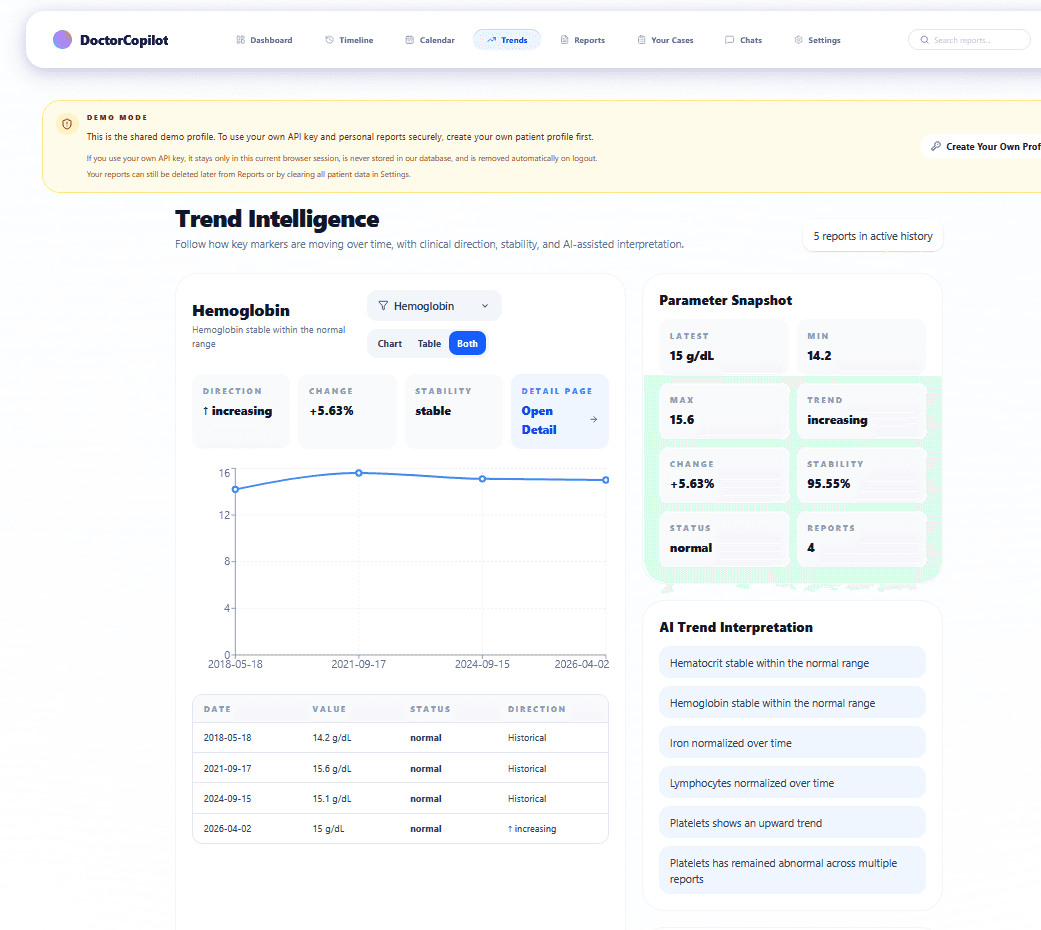
Trend intelligence
Trend Intelligence is where the product becomes especially convincing: historical values, movement, stability, and AI interpretation are all shown together.
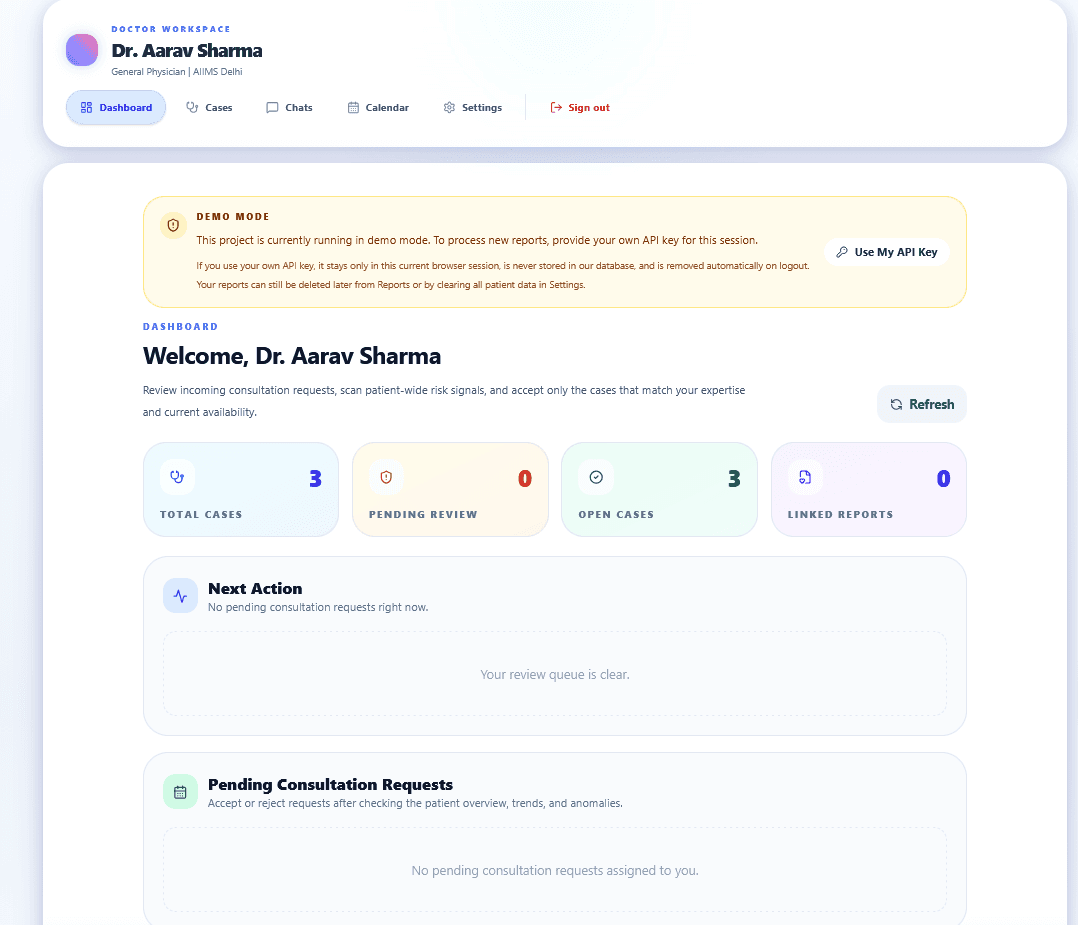
Doctor workspace
The doctor workspace keeps pending care activity, review state, and operational context in one place so the clinical side feels real too.
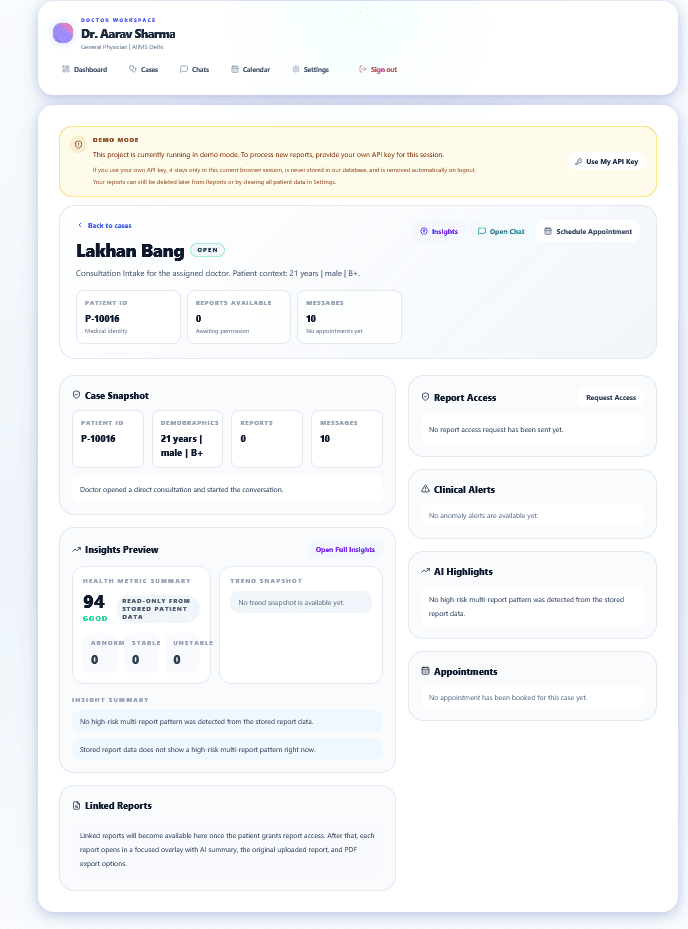
A doctor can move from intake to case action without leaving context.
This screen ties together patient identity, linked reports, insights, alerts, appointments, and conversation state. That is what makes DoctorCopilot read as a product instead of a one-screen dashboard.
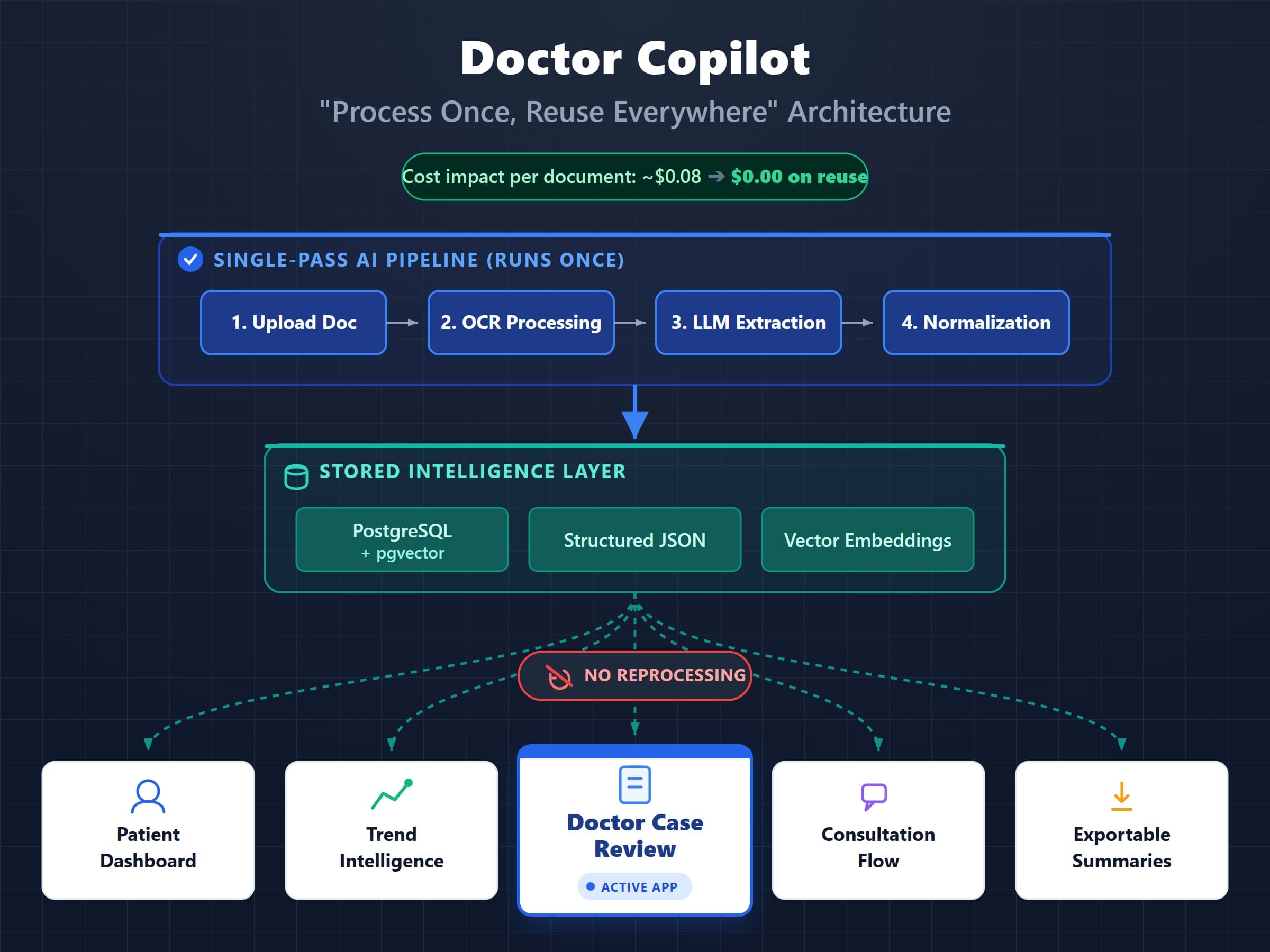
The interface matches the backend idea: process once, reuse everywhere.
This diagram backs up the product claim with the actual system shape: single-pass AI at upload time, stored intelligence, and multiple surfaces reading the same state.
One page, three levels of understanding.
This case study is designed so a beginner, developer, or academic evaluator can all understand the same product without needing different explanations.
A product that makes medical reports easier to read and reuse.
Patients upload reports once. DoctorCopilot extracts the important values, keeps them structured, and turns them into a readable health history instead of a pile of PDFs.
A role-based full-stack product, not just an AI endpoint.
React + Vite portals talk to a FastAPI backend that handles authentication, uploads, OCR, AI extraction, case APIs, report access, realtime chat, and appointments.
A complete path from upload to clinical review.
This project connects product design, medical data normalization, trend tracking, doctor review, patient permissions, and cloud deployment in one clear product.
Three users, one shared medical product.
DoctorCopilot is not a single dashboard pretending to be a platform. Each role has its own responsibility, interface, and data access pattern.
Personal Health Dashboard
The patient portal is designed to feel calm and legible. It explains what changed, what matters, and when a doctor should be involved.
Case Review Workspace
The doctor portal starts with context first: pending requests, patient overview, linked reports, AI highlights, and appointments inside one case workspace.
Operations And Oversight
The admin layer keeps doctors, patients, cases, and reports manageable. It is not decorative; it completes the product as something teams could actually run.
How the product moves from upload to treatment.
This is the plain-English version of the product. It is the shortest path to understanding what DoctorCopilot actually does in real use.
Role-based sign in
Public IDs like P-10005 and D-10001 route each user into the correct portal through JWT auth.
Upload once
A patient uploads a report and the backend stores the original file before processing begins.
Process once
OCR, metadata extraction, OpenAI structuring, and clinical normalization happen at upload time.
Reuse everywhere
Dashboards, trends, case insights, and exports reuse stored medical data instead of recomputing AI every time.
Act on it
Doctors review the case, request report access, chat with the patient, and schedule follow-up care.
The product looks like a real tool because it is one.
These sections are based on the actual DoctorCopilot patient dashboard, doctor dashboard, and doctor case workspace flows inside the source project.
From raw report file to doctor-ready case context.
This sequence is grounded in the real FastAPI processing orchestrator. It shows exactly how DoctorCopilot transforms a medical upload into reusable application state.
The original report is stored before anything clever happens.
DoctorCopilot starts with provenance. The file is saved, a report record is created, and the processing log starts immediately so the product always knows what entered the pipeline.
How the project is made and why it feels complete.
DoctorCopilot works because the product layer, AI pipeline, and day-to-day operations are tied together intentionally instead of existing as separate demos.
Experience Layer
React + Vite portals power the patient, doctor, and admin surfaces, while Tailwind and Framer Motion shape the visual system and transitions.
Application Layer
FastAPI handles JWT authentication, role protection, uploads, case APIs, doctor review actions, exports, and realtime messaging.
Clinical Intelligence
OCR, OpenAI structured extraction, numeric repair, normalization, classification, trends, and anomalies turn report text into product-ready health context.
Deployment Split
The live setup separates frontend and backend cleanly: Vercel serves the product UI, Railway runs the API, and the data layer keeps reports, cases, appointments, and messages persistent.
That design choice is what makes DoctorCopilot feel like a real application instead of an expensive prompt loop. The patient dashboard, trends, doctor insights, exports, and case views all become faster, cheaper, and easier to trust.